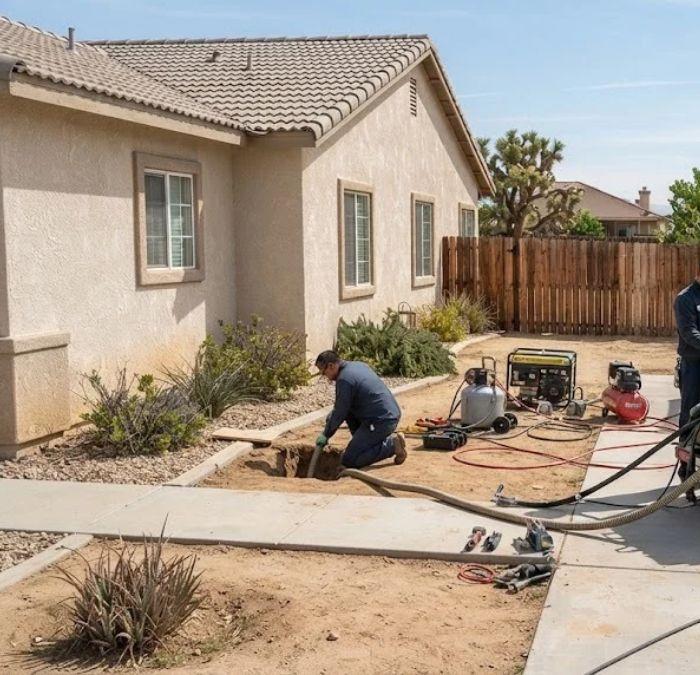
A Damaged Sewer Line Doesn't Always Mean Digging Up Your Yard
If a camera inspection has confirmed a cracked, root-intruded, or offset section of sewer line, the traditional fix is excavation - digging a trench along the pipe's path to access and replace it. Trenchless pipe lining reinforces the damaged section from the inside instead, through the existing access points, which means your yard, driveway, or landscaping generally stays intact.
Cured-in-Place Pipe, Explained
A flexible liner saturated with a special resin is inserted into the damaged pipe through an existing cleanout or access point, then inflated so it presses against the pipe's interior walls. The resin cures in place, hardening into a smooth, jointless new pipe surface inside the old one. Once cured, the lined section functions as a new pipe wall, sealing over the cracks, offset joints, or root-entry points that caused the original problem.
Lining vs. Full Excavation
Lining works well for a damaged section that's structurally intact enough to support a liner - cracks, root intrusion, and joint separation are all good candidates. A fully collapsed section, a severe grade problem, or a line that's shifted too far out of alignment usually still needs traditional excavation, since there's no longer a stable pipe wall for a liner to bond against. The camera inspection that confirms the damage in the first place is also what tells us honestly which category your situation falls into.
Soil Movement Makes This Worth Knowing About
The same clay and sandy-loam soil expansion-and-contraction cycle that stresses buried pipe elsewhere in Lancaster is a real, recurring cause of the joint separation and cracking that makes a sewer line a lining candidate in the first place. Lining is often a good match for exactly this kind of damage, since it's typically joint-level or crack-level rather than a full structural collapse.
Lifespan and Disruption
- ●
A properly installed liner is rated for decades of service life, comparable to a new pipe.
- ●
Landscaping, hardscaping, and driveways generally aren't disturbed, since the work happens through existing access points.
- ●
The job is typically completed in a single day for a standard residential line, compared to potentially several days for excavation and restoration.
The Camera Inspection Always Comes First
We never quote or schedule a lining job without first running a video camera through the affected section to confirm the damage's exact location, extent, and character. This isn't a formality - it's what determines whether lining is actually appropriate for your specific situation, where the liner needs to start and end, and whether any debris or root material needs to be cleared out before the liner can be installed. Skipping this step and guessing at a repair plan is how a lining job ends up not fully solving the underlying problem.
Why Lining Often Costs Less Overall
Excavation costs aren't limited to the digging itself - restoring landscaping, hardscaping, or a driveway afterward often adds significantly to the total project cost and timeline. Lining's higher per-foot material cost is frequently offset by the restoration work it avoids entirely, which is part of why it's become the preferred option for qualifying damage rather than just a premium alternative.
Lining Works for Larger Diameter Lines Too
Trenchless lining isn't limited to residential sewer laterals - the same technology applies to larger commercial sewer and drain lines, where excavation would mean disrupting a parking lot, a building foundation area, or ongoing business operations for potentially days at a time. For a commercial property in Lancaster's logistics or retail sector dealing with an aging or damaged line, lining is worth raising as an option before assuming a costly, disruptive dig is the only path forward.
Questions
Generally no - the liner is installed through existing access points like a cleanout, so landscaping and hardscaping are typically left undisturbed.
A properly installed liner is rated for decades of service, comparable to installing a new pipe.
Most crack, joint-separation, and root-intrusion damage is a good fit. A fully collapsed section or severe misalignment usually still needs traditional excavation - the camera inspection tells us which category applies.
Usually not for the pipe itself. Occasionally a small access pit is needed if there's no suitable existing cleanout, but it's far less disruptive than excavating the full pipe run.
Ready When You Are
Call (714) 750-8637 - we'll get to Lancaster soon.