Low Water Pressure in an Older Lancaster Home: Likely Culprits
It's rarely a mystery - it's one of four specific causes, and a quick process of elimination usually finds the right one.
Low water pressure in an older Lancaster home usually isn't one single problem - it's one of a handful of specific, diagnosable causes, and which one it is changes the fix entirely. Guessing wastes time; a process of elimination gets to the answer fast.
Scale Narrowing the Pipes From the Inside
Lancaster's extremely hard water deposits mineral scale on the interior of pipes over years, and in a home with original galvanized supply lines, that buildup can narrow the effective diameter of the pipe significantly. This shows up as gradually worsening pressure across the whole house rather than a sudden drop, and it's a strong sign the underlying pipe material itself - not just a single fixture - is the issue.
A Failing Pressure Regulator
Most homes on municipal water have a pressure-reducing valve where the main line enters the house, keeping incoming pressure at a safe, consistent level. When that valve fails, pressure can drop suddenly and uniformly at every fixture, which is a different pattern than the gradual decline scale buildup causes. A regulator is a relatively straightforward, inexpensive part to test and replace once it's confirmed as the cause.
A Hidden Leak Somewhere in the System
Water escaping through an undetected leak - including a slab leak under a foundation - reduces the pressure and volume actually reaching your fixtures, since some of it never arrives at all. This is one of the reasons a slab leak often shows up first as reduced pressure rather than visible water, and it's worth ruling out with a water meter check before assuming the cause is mechanical. Our slab leak detection page covers exactly how that check works.
A Localized Clog or Fixture Issue
If low pressure is isolated to one faucet or showerhead rather than the whole house, the cause is almost always local - a clogged aerator, a scaled showerhead, or debris in a single supply line - rather than anything affecting the home's plumbing system as a whole. This is the easiest cause to rule out first, since cleaning or replacing one fixture's aerator takes minutes and costs very little.
A Simple Process of Elimination
Check whether the issue is at one fixture or the whole house first - that alone separates cause 4 from the other three. If it's whole-house, a sudden onset points toward the regulator or a new leak, while a gradual decline over months or years points toward scale buildup in older pipe. From there, a water meter check with everything off is the fastest way to confirm or rule out a hidden leak before assuming it's mechanical.
What a Professional Pressure Test Actually Shows
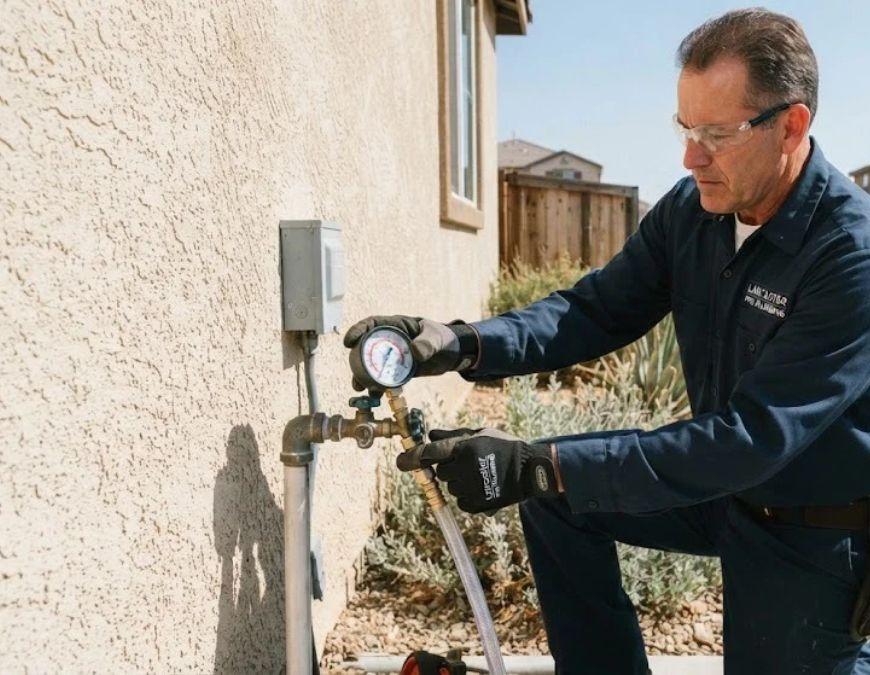
A pressure gauge threaded onto an outdoor spigot gives a precise reading in pounds per square inch, and comparing that to the healthy range for residential plumbing tells us immediately whether the whole system is under-pressured or whether the problem is isolated to specific fixtures reading fine on the gauge but weak at the tap. This single test usually narrows the four causes down to one or two candidates before any further diagnostic work starts, which is why it's typically the first thing done on a low-pressure call rather than guessing based on symptoms alone.
Why This Is Worth Fixing, Not Living With
Low pressure that's tolerated for years because it's "not that bad" often means one of the four causes above is quietly getting worse - scale keeps accumulating, a small leak keeps growing, or a struggling regulator keeps degrading. Treating persistently low pressure as background noise rather than a diagnosable symptom is how a simple aerator swap turns into a full pipe replacement a few years later. Catching the actual cause early is almost always the cheaper path.
Sudden vs. Gradual: Why the Distinction Changes Everything
Homeowners often describe low pressure as one problem, but "it dropped overnight" and "it's been getting worse for two years" point toward almost entirely different causes and should be treated as different questions. A sudden drop is time-sensitive and worth investigating within days, since it can mean an active leak or a regulator that just failed. A gradual decline is less urgent in the moment but represents accumulated scale that's only going to keep narrowing pipe further the longer it's left, so "gradual" doesn't mean "ignorable" - it just means there's less of a rush to call today versus this week.
If You're on a Private Well Instead of Municipal Water
A small number of Lancaster and Antelope Valley properties draw from a private well rather than the municipal system - a real, documented feature of this groundwater basin, not a rare exception - and low pressure there can point toward a failing well pump or pressure tank in addition to the four causes above, a distinct diagnostic path that starts at the wellhead rather than the water meter. If your property is on a well, mentioning that upfront when you call helps route the diagnosis to the right starting point immediately, rather than working through the municipal-system causes first and only reaching the well pump last.
FAQ
Yes, particularly in a home with original galvanized pipe, where decades of mineral scale can measurably narrow the interior diameter of the supply lines.
A sudden, dramatic pressure drop can indicate an active leak, including a slab leak, and is worth investigating promptly rather than waiting - though it's rarely a life-safety emergency the way a gas leak would be.
Need a Plumber in Lancaster?
Call (714) 750-8637 - we'll get to Lancaster soon.